
Insights · in-room dining
Ready Meals for Student Accommodation: Hot Food to the Room With No Kitchen and No Chef

The short answer. Ready meals for student accommodation are chef-made dishes cooked and blast-frozen in a production kitchen, then finished in the building by the team already on shift and taken to the resident's door: 3–10 minutes in a combi oven, air fryer or microwave, no commercial kitchen and no chef. Food cost is £3.10 to £6.50 a portion, ex VAT, with no management fee; the building needs an upright freezer and a Scan-to-Cook Station, bought or hired. Nova Chef's student accommodation offer is built on the range that runs room service in 60 UK hotels, developed by Culinary Director Sergey Men, a Michelin-Guide restaurateur, and made in a SALSA-certified kitchen in London.
Who it suits: premium purpose-built student accommodation (PBSA) and residences with no kitchen, buildings losing evening orders to delivery apps, and operators who want in-room dining as part of the rent proposition without an F&B department. Read on for how it works, what it costs, who supplies it and what the evidence looks like.
Updated 5 November 2026.
The Tuesday night problem
Ask a student in a premium residence what they eat on a Tuesday in November with a deadline at midnight, and the answer is a delivery app. The revenue leaves the building, the wait is forty-five minutes, and the quality is whatever arrived on a moped. Residents in premium accommodation expect to eat well without leaving the building, and the building earns nothing from it.
The obvious fix is a kitchen and a chef. It is also the most expensive fix available. A commercial kitchen consumes lettable space, demands extraction and drainage, and commits the operator to a permanent payroll of skilled staff in the tightest labour market British hospitality has seen. Demand in a residence is peaky by nature: quiet in August, relentless in exam season. A fixed cost base under peaky demand is a structural loss.
What "ready meals for student accommodation" actually means
Not the supermarket kind, and not a vending machine. The cooking happens once, in a production kitchen: professional chefs cook the dishes, portion them and blast-freeze them at the point they would normally be plated. Freezing is the preservation method, so there are no preservatives and the packs keep for up to 12 months. What happens in the building is finishing, not cooking.
The difference from a retail ready meal is that everything is built for service. Portions are sized for a plate, every pack carries its finishing instructions and allergen data on the label, and the range covers what residents order at ten at night: burgers and chips, crispy chicken, pasta, curries, rice bowls, slow-cooked mains, and vegetarian and vegan dishes across the menu.
How a residence serves hot food with no kitchen and no chef
- Store: the dishes arrive frozen and go into an upright freezer back of house. No prep area, no extraction, no fit-out; the freezer and the station each run off a standard plug socket.
- Scan and heat: when an order comes in, whoever is on shift scans the barcode on the pack. The Scan-to-Cook Station programs the combi oven, air fryer or microwave with that product's mode, temperature and time and runs it. Nobody chooses a setting and nothing is left to judgement.
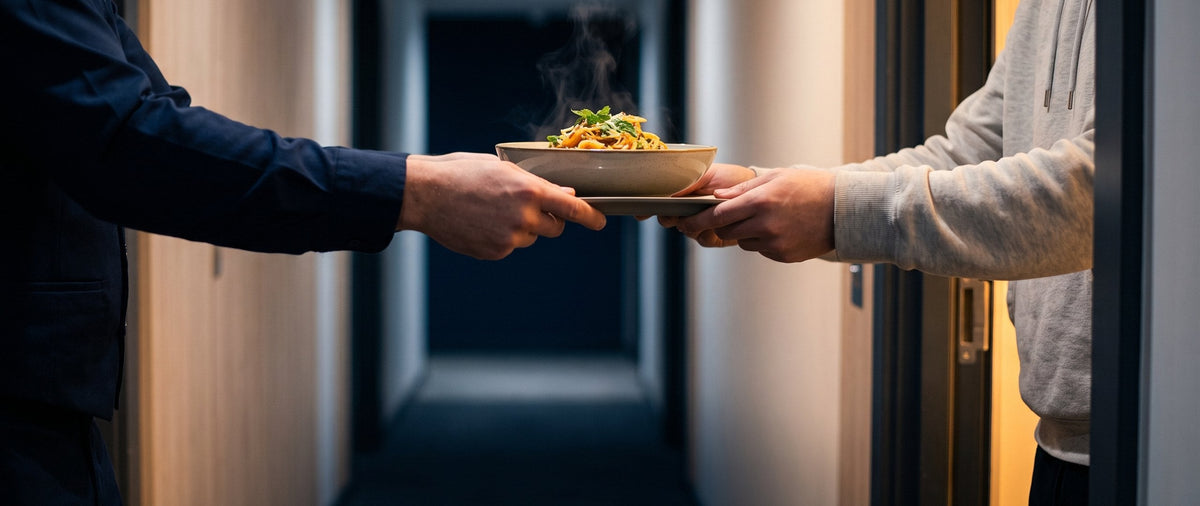
- Serve: the station signals when the dish is ready. The team plates it and takes it to the door, the same operation as hotel room service. Training takes about an hour: scan, place, serve.
The operation behind it is written down. Nova Chef develops the menu for the building and writes the standard operating procedures: ordering, storage, stock rotation, finishing, allergen handling, delivery to the door and what to do on the night something goes wrong, in the language of a duty manager rather than a chef. Most residences that take this on have never run a food service before, and that is the situation the model is designed for.
What it costs a residence
| Per portion, in-room dining | Nova Chef range |
|---|---|
| Food cost per portion | £3.10 to £6.50, ex VAT, depending on the dish |
| Management fee or service charge | None |
| Commercial kitchen or fit-out | Not needed; no extraction, drainage or raw-prep area |
| Equipment | An upright freezer and the Scan-to-Cook Station, bought or hired monthly |
| Kitchen staff | None; front-of-house, concierge or night staff finish and deliver |
| Menu, procedures, allergen data | Included: menu built for the building, written SOPs, labelled allergens |
| Minimum order | From £500, delivered frozen |
| Time to launch | About two weeks from first conversation to serving |
A worked example: a dish that costs £4.50 to buy and sells to a resident at £9.60 including VAT brings in £8.00 ex VAT, a margin of £3.50 on a plate that would otherwise have gone to a delivery app and earned the building nothing. The rate for a specific building is confirmed once its size and expected demand are known. For how per-portion supply compares with employing or contracting a chef, see what a chef really costs in 2026.
Who supplies ready meals to student accommodation in the UK, and which type you need
Three kinds of supplier answer this search, and they solve different problems:
- Hospitality specialists (Nova Chef): chef-developed dishes finished by the building's own staff with barcode-programmed equipment, with menu development, operating procedures and allergen documentation included. Choose this if the building has no kitchen and no F&B team, and the goal is in-room dining that pays for itself.
- Contract caterers (Sodexo, Compass, Aramark): staffed campus kitchens, dining halls and cafés run under a management fee. Choose this if you have a dining hall, hundreds of covers a day and the space and budget for a brigade.
- Delivery apps and retail ready meals: what residents use today. Convenient for the resident, but the revenue and the relationship leave the building, and the operator has no say in the quality.
Most premium residences are too small for a contract caterer's kitchen and too large to ignore the demand. That is the gap in-room dining finished by the existing team fills.
What the evidence looks like
The clearest student example is a UK university with heavy demand between 8pm and 1am from students working late, no overnight kitchen staff, and residents defaulting to fast food. Nova Chef's dishes, finished on demand with no extra staffing, replaced that with chef-made meals available through the night.
The operation itself is proven at scale in hotels, which is where the model comes from. Nova Chef supplies 60 UK hotels, including a five-star property near the Bank of England whose overnight room service runs without a night kitchen team. "It tastes amazing. It's zero labour, and it's so easy," says an F&B Director at Hilton Hotels UK & Ireland. At Fraser Place Canary Wharf, a serviced-apartment building, the team reports "the food is absolutely amazing, with great feedback from everyone." In-room dining in a student residence is the same operation for a different resident; video testimonials are on the student accommodation page.
Welcome weeks, events and communal dining
Individual portions are the everyday service: finished to order in minutes, right for room delivery, late openings and unpredictable demand. For welcome week, resident events and shared dining, multi-portion catering packs are prepared centrally and finished on site in a combi oven, served without catering staff. Halal-friendly options are available, and full allergen information is supplied for every dish.
When this is not the answer
A campus with a dining hall, a thousand covers a day and a catered-halls contract is a contract caterer's job. The in-room model fits premium residences and PBSA buildings with no kitchen, where food is part of the rent proposition rather than a canteen, and where the operator wants the service to run on the staff already in the building.
FAQs
Can a student residence serve hot food without a commercial kitchen?
Yes. No raw food is prepared on site, so there is no requirement for extraction, drainage or a raw-prep area. Chef-made dishes arrive frozen; the building's own team scans the barcode on the pack and the Scan-to-Cook Station programs a combi oven, air fryer or microwave and runs the right setting. An upright freezer and the station, each on a standard plug socket, are the whole footprint.
Who cooks the food in a student residence?
Nobody on site cooks. Dishes are cooked by professional chefs in Nova Chef's SALSA-certified kitchen in North West London and finished in the building by front-of-house, concierge or night staff after about an hour of training. The dish comes out the same whoever is on shift.
How does the food reach residents' rooms?
The team finishes and plates the order back of house and takes it to the door, the same operation as hotel room service without the kitchen or the chef behind it. Individual portions take 3–10 minutes from frozen.
What do ready meals for student accommodation cost?
Nova Chef's range is £3.10 to £6.50 a portion, ex VAT, depending on the dish, with no management fee or service charge. The building needs an upright freezer and the Scan-to-Cook Station, which can be bought or hired monthly. The rate for a specific building is confirmed once its size and expected demand are known.
Can the service run late at night and in exam weeks?
Yes. Because it does not depend on a kitchen shift, it runs whenever staff are on duty, which is exactly when residences lose orders to delivery apps: late evenings, Sunday nights and exam season.
Who supplies ready meals to student accommodation in the UK?
Three kinds of supplier. Hospitality specialists such as Nova Chef supply chef-developed dishes finished by the building's own staff, with the menu, operating procedures and allergen data included. Contract caterers such as Sodexo, Compass and Aramark run staffed campus kitchens and dining halls under a management fee. Delivery apps and retail ready meals feed residents too, but the revenue leaves the building and the quality is whatever arrives.
Is the food good enough for a premium residence?
Menus are developed by Culinary Director Sergey Men, a Michelin-Guide restaurateur, and cooked by professional chefs, then blast-frozen at their peak and finished to order. The same range runs room service and bar menus in 60 UK hotels, including Hilton, Marriott, IHG and Radisson Individuals properties. A tasting at the building is free.
How quickly can a residence launch?
Typically about two weeks from first conversation to serving: a tasting, then the freezer and station installed in days rather than a fit-out, about an hour of staff training, and launch with a named account contact.
Related reading
- Student accommodation catering: hot food to their room, no kitchen, no chef
- Aparthotel and serviced apartment food
- University × Nova Chef: 24/7 smart freezer dining for late-night scholars
- Best ready meal solutions for hotels to replace room service
- What a Chef Really Costs in 2026: Employed, Agency, or Per Portion
- The Scan-to-Cook Station
Taste it before you decide.
We bring the food to your venue, your team cooks it, you judge it. No commitment.